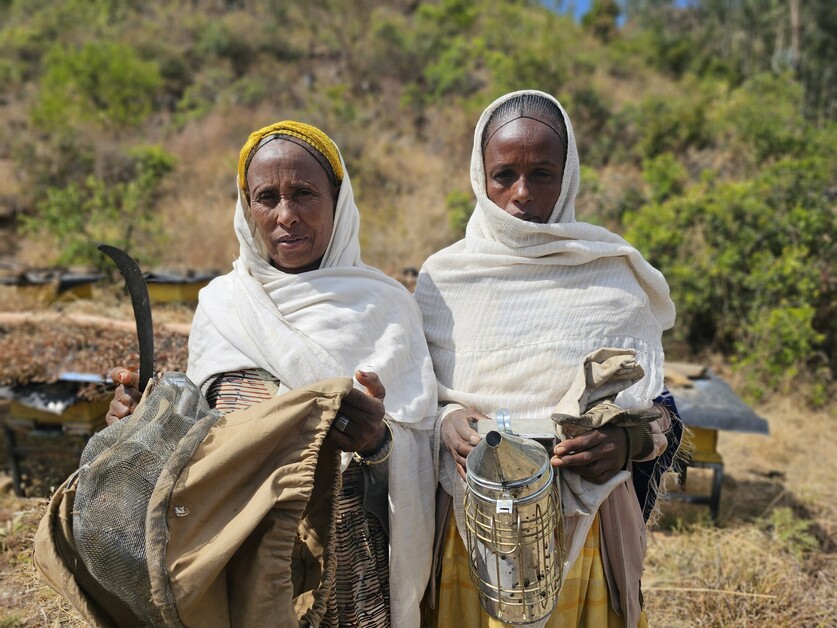
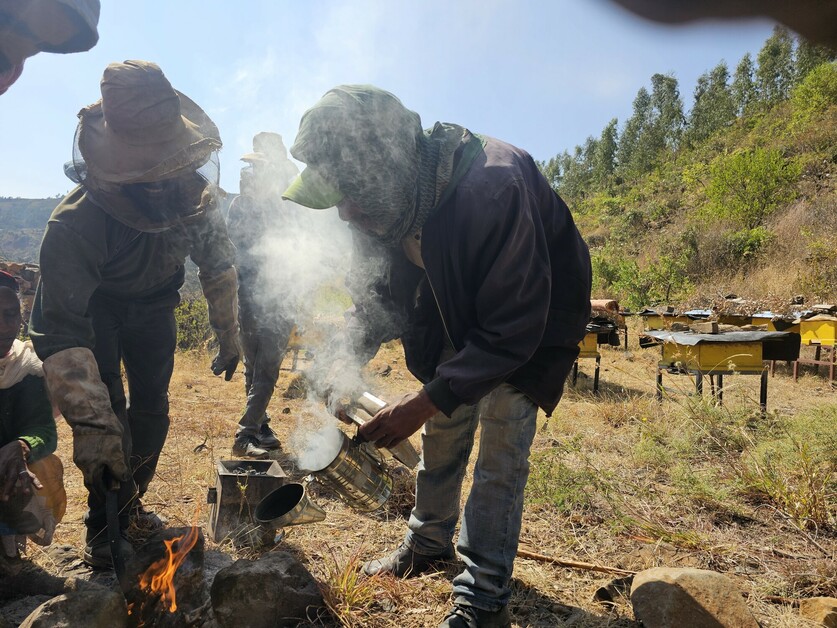
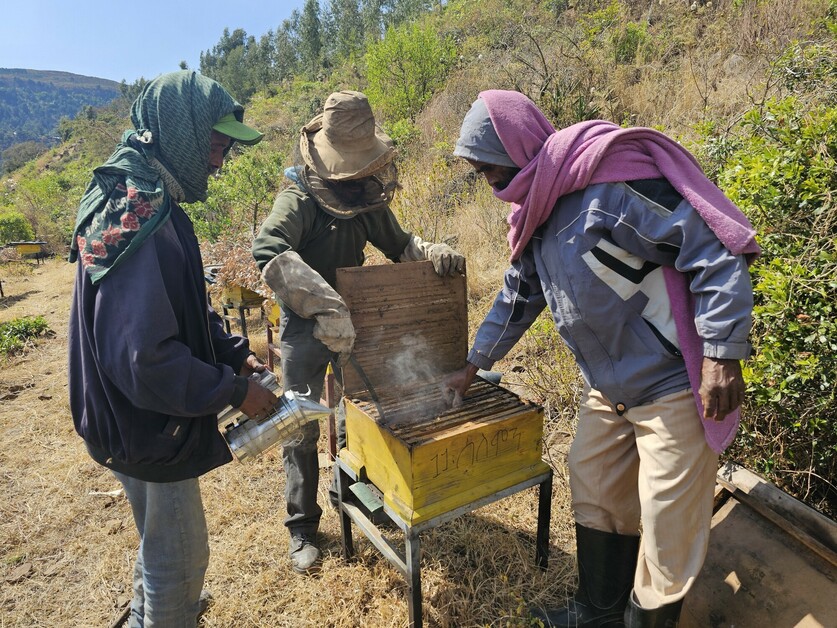
In picture: In picture: Tsega, 55, and Gergis, a fellow member of the bee cooperative - Gergis is holding the bee smoker, Tsega the protective mask and a knife to open the bee hives
“Living here has become very difficult as we do not have enough food in our village,” says Tsega, 55, while holding on to an empty basket. She lives in a small village of around 1.200 people in the middle of a mountain range in Northern Tigray. “And the situation is only getting worse,” Tsega adds. Overall, according to the World Food Programme, 15.8 million people in Ethiopia need food assistance in 2024 due to the drought, economic situation, and conflict. With Tigray being heavily impacted. “We did not have enough food for the last four years now. We are just trying to survive until the next day, hoping not to starve,” says Tsega.
The 55-year-old is part of a bee cooperative supported by CARE and a partner organization in the SELAM project. The twenty group members come together to take care of bee colonies to produce enough honey to sell on the market and with this generate income for their families. CARE supported the cooperative with 120.000 bees, 40 beehives, and 26kg of wax. “Compared to other farmers in our community, we are very lucky because at least we have the bees,” says Tsega who starts preparing a small fire on the floor. She puts some wood and coals in the middle and one of the group members waves her basket to create more smoke. She then adds more wood to the bee smoker, which is used to calm the bees. The bee cooperative was founded several years ago. “All my hope was with the bees. I do not have land or any other source of income. But with the money we got from selling the honey twice a year, I had a good life. I even bought schoolbooks, pens, shoes, and food for my children,” describes Gebregergis, 51, father of eight who is also a member of the cooperative. Then came the conflict. The beehives burned down, the bees died, and the cooperative collapsed.
“We cannot describe with words the suffering during the conflict. When we heard gunfire we ran away and left everything behind. We hid in caves during the day to survive. We left early in the morning and during the night we came back and tried to find food,” describes Gerbregergis. Many of his and Tsega’s neighbors died. “We are farmers, what do we know of fighting? Up that hill one of our cows was killed by an air strike,” he continues, lowering the ready bee smoker to the ground with a heavy sigh. “We cannot call it life. Six of our neighbors were injured during the conflict. They still cannot walk and will never be able to again,” Tsega adds. Walking is crucial in this area which is located in a steep mountain range and can only be reached by foot and by walking for half an hour downhill through rock formations and wild nature. The villagers walk everywhere. They walk to find food. They walk two hours to the next market to sell their livestock. They walk to find water and grazing areas for their animals. Young and old walk and climb through rocky terrain with children on their backs, a jerrican in one hand and a basket with bread in the other, herding cows in front of them. “If you cannot walk here, you die,” says Tsega and hands Gerbregergis some protective gear: a hat with a face net, some gloves, and sleeves.
“We live in a very bad situation. We are starving because there is not enough food. First, there was the conflict, now we have the drought and no harvest. Even the bees are weak because there are fewer flowers and no water for them to drink. They must go very far to places with irrigation. They often do not have enough strength to come back,” says Gerbregergis, walking over to one of the beehives with his knife.
“During the conflict, we had no hope, but with the new bees and hives hope has returned. The bees or our chance to survive. I have seven children, my oldest is in grade eight. She often goes to school without a pen or breakfast. I hope the bees will change that,” says Tsega.