V košíku nic není.
Technické hodnocení
Provedení 2 genderově citlivých technických hodnocení WASH na nefunkčních vodních systémech k identifikaci potřebných oprav a modernizací.
V roce 2024 se zaměřujeme nově také na oblasti Adirkaye a Tselemet v zóně Severní Gondar, která je součástí regionu Amhara v Etiopii. Tato oblast čelí extrémnímu nedostatku bezpečné pitné vody, suchem a následky konfliktů. V Severním Gondaru je přibližně třetina vodních zařízení nefunkční, což postihuje téměř 600 000 lidí. Tato krize je zhoršena nedostatkem srážek, zvýšenou evapotranspirací a nefunkčními vodními systémy, což vede k neúrodě a rozsáhlým suchem. Navíc, špatná ekonomická situace místního obyvatelstva a nedostatečná hygienická a sanitární infrastruktura výrazně zvyšují riziko propuknutí nemocí souvisejících s nedostatkem vody, jako je cholera.
CARE Česká republika v Etiopii dlouhodobě pomáhá. Opravujeme studny, poskytujeme pitnou vodu, potraviny a zdravotní péči těm, kteří to nejvíce potřebují. Vaše podpora je klíčová. Společně můžeme těmto rodinám pomoci přežít a dát jim šanci na lepší zítřek.
Děkujeme.


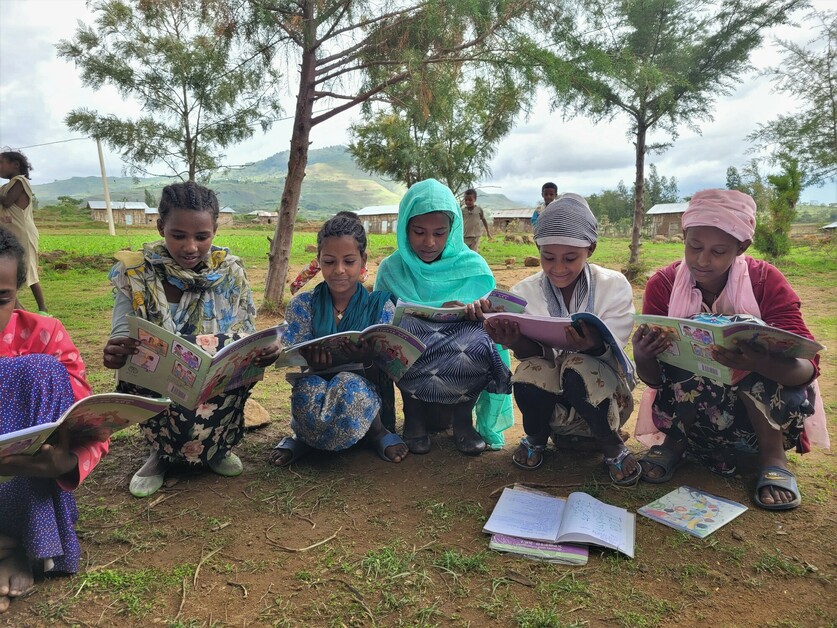
CARE initiated girls’ groups in communities that teach girls through different discussion sessions about life skills. The girls come together and sit on small stones in a big circle. They come together and study their workbooks and discuss about social norms in ther community. They gain self-confidence and learn how to negotiate and to stand up for themselves. Eyerus, a member of a girls group aged 10 to 14 negotiated with her father until he agreed to cancel a proposal that he already agreed to. Tadella, 14, a member of the group, was very shy before she joined this group, now she learnt how to speak up.
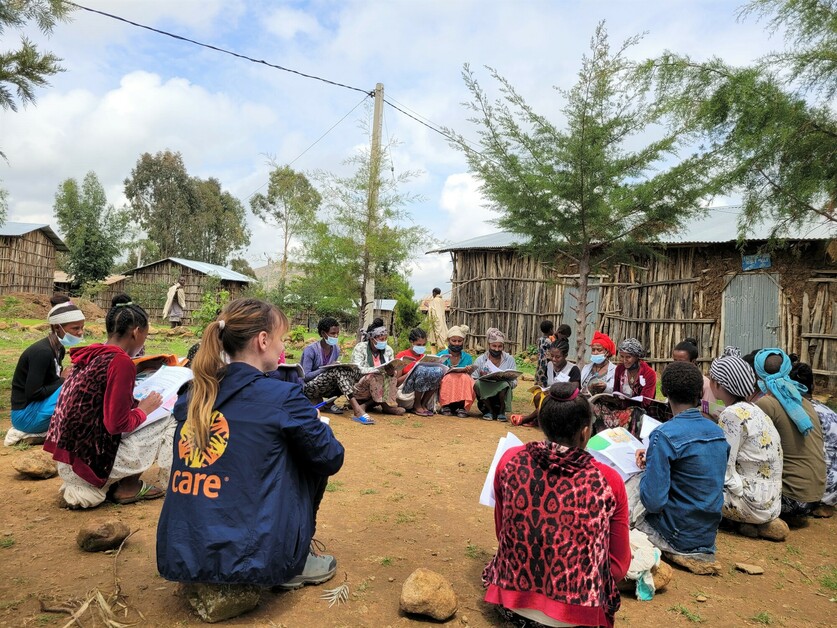
Sarah Easter, CARE Emergency Communications Officer with a CARE girls group in Ethiopia.
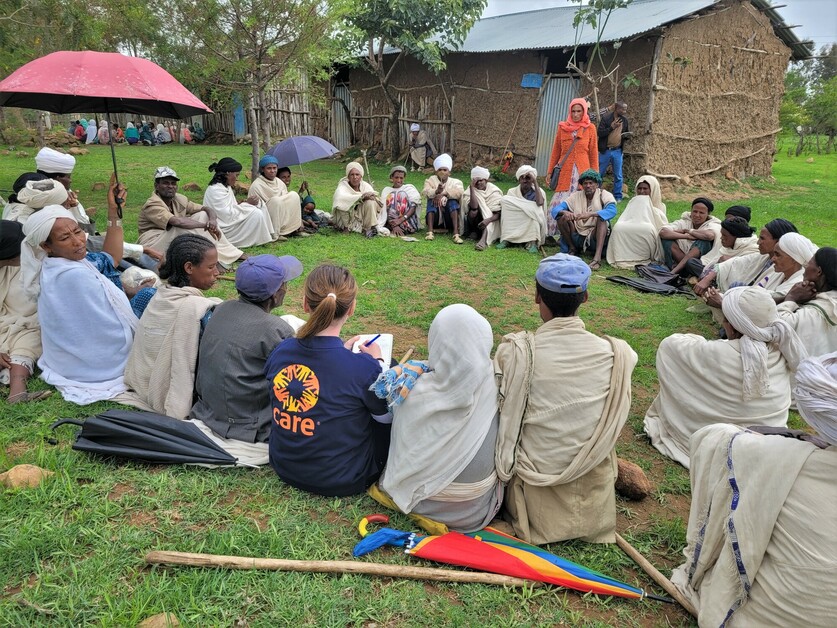
Sarah Easter, CARE Emergency Communications Officer with member of a CARE SAA-group.
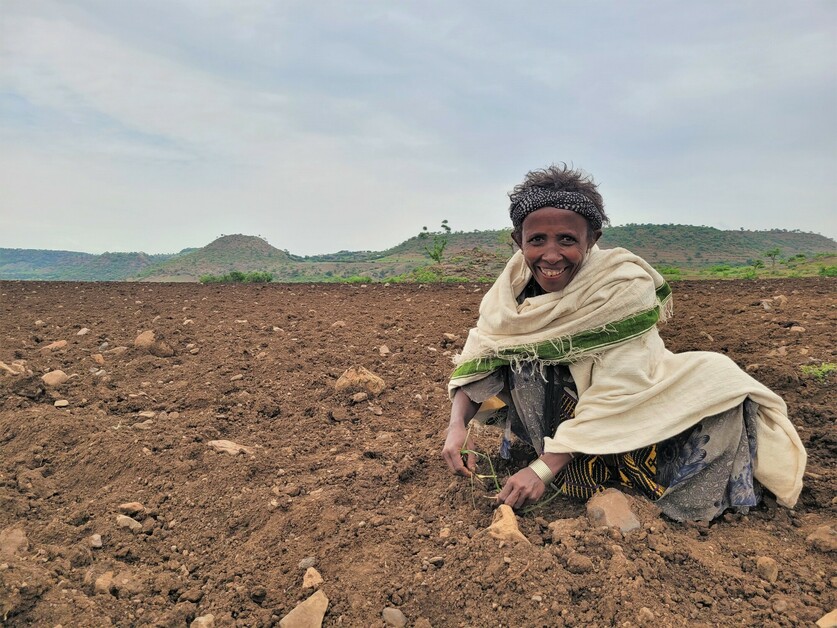
Amsal Abrea, 40, on one of her fields.
Climate change is affecting communities in Ethiopia. The country is facing the worst drought in the last 40 years. Women and girls have to walk long distances to find water. Livestock are dying and the fields are not producing enough crops. Livelihoods are at risk.
Access to water is also for farmers very important. CARE helps farmers with a solar-powered irrigation system. Before Amsal’s fields were dry and she always faced the risk of losing her crops. Her fields are now supplied with enough water. “I produce twice as many crops as I did before,” the mother of seven children says, “It totally changed my livelihood. I eat three times a day instead of only twice and I can provide for my children’s education.”
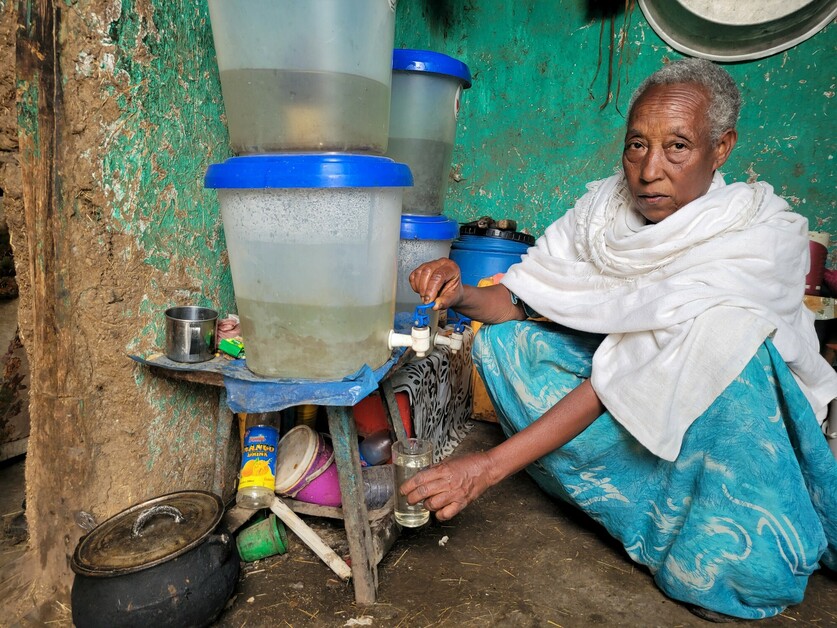
CARE supports the community with filtrations systems to have access to clean water. “Now that we filter our drinking water, we reduced many illnesses and have fewer health center visits. We now know that we cannot drink the water without filtration. If we do, we will face a severe health challenge. I support my community by educating my neighbors and teach them how to build a filter with local material”, says Yalga.
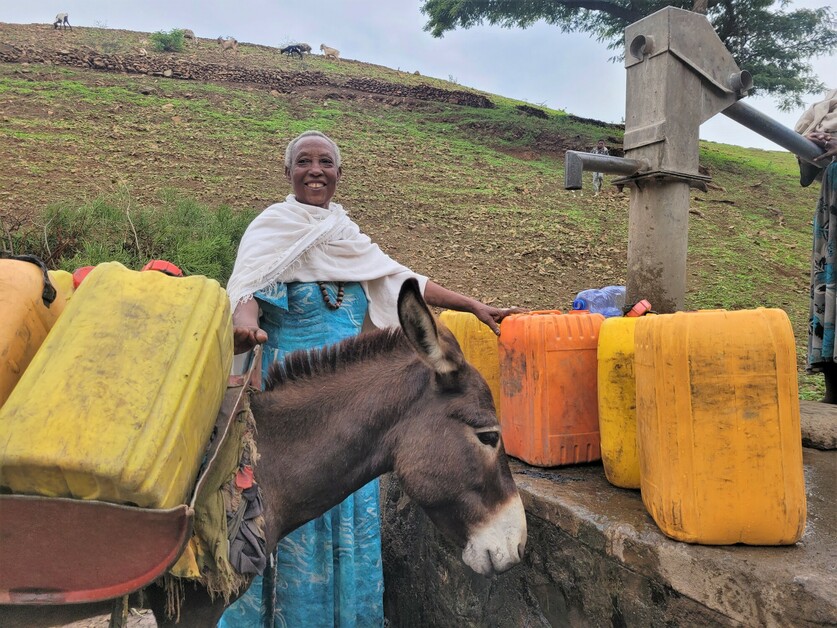
Yalga, 70, fetching water at a water pump, installed by the community together with CARE.
Climate change is affecting communities in Ethiopia. The country is facing the worst drought in the last 40 years. Women and girls have to walk long distances to find water. Livestock are dying and the fields are not producing enough crops. Livelihoods are at risk.
It is the women and girls that need to go and find water. Due to the drought, it can take up to two hours of walking to find a source. Girls drop out of school, because they have to walk the whole day to fetch water for their families.
After walking for hours, the women and girls find a small water hole or a stream that still has water. The water is dirty. Livestock also drink from it. The water is full of their feces and excrements. “Little worms live in the water, that suck the blood out of your mouth. Drinking water from an unprotected source made us very ill. Diarrhea and vomiting are the most common,” explains Bosse, 40. Drinking contaminated water full of bacteria has serious health effects that can compromise the immune system severely, cause infections and sometimes even lead to death.
That is why it is crucial to have access to a protected water source. In water projects, CARE supports the communities by building wells and water pumps close to the villages. The area around the water pump is protected by the community. “We plant trees and other plants. With gabions we build barriers to control the water flow. No livestock is allowed to enter this area. Before we had this protected environment, we had enough water for a month. But now the ground water is rising, and we already have enough for six months. We understand the importance and will continue planting more trees to have enough water for the whole year,” explains Bosse.
“Having access to water changed our community. Women have less household chores and girls can go back to school and receive an education instead of fetching water the whole day. We changed our mindset. Now we treat the trees in the protected environment like our children,” reflects Yalga, 70.
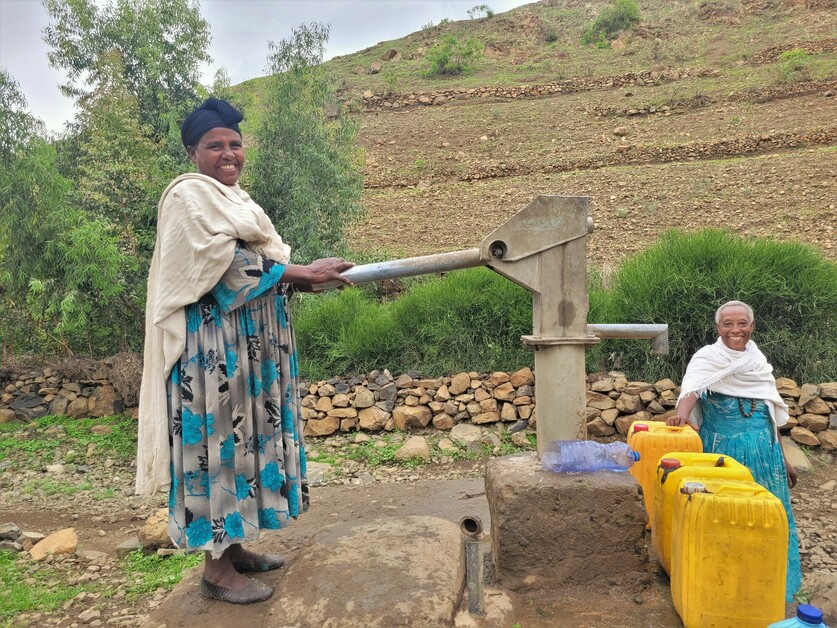
Bosse, 40, and Yalga, 70, fetching water at a water pump, installed by the community together with CARE.
Climate change is affecting communities in Ethiopia. The country is facing the worst drought in the last 40 years. Women and girls have to walk long distances to find water. Livestock are dying and the fields are not producing enough crops. Livelihoods are at risk.
It is the women and girls that need to go and find water. Due to the drought, it can take up to two hours of walking to find a source. Girls drop out of school, because they have to walk the whole day to fetch water for their families.
After walking for hours, the women and girls find a small water hole or a stream that still has water. The water is dirty. Livestock also drink from it. The water is full of their feces and excrements. “Little worms live in the water, that suck the blood out of your mouth. Drinking water from an unprotected source made us very ill. Diarrhea and vomiting are the most common,” explains Bosse, 40. Drinking contaminated water full of bacteria has serious health effects that can compromise the immune system severely, cause infections and sometimes even lead to death.
That is why it is crucial to have access to a protected water source. In water projects, CARE supports the communities by building wells and water pumps close to the villages. The area around the water pump is protected by the community. “We plant trees and other plants. With gabions we build barriers to control the water flow. No livestock is allowed to enter this area. Before we had this protected environment, we had enough water for a month. But now the ground water is rising, and we already have enough for six months. We understand the importance and will continue planting more trees to have enough water for the whole year,” explains Bosse.
“Having access to water changed our community. Women have less household chores and girls can go back to school and receive an education instead of fetching water the whole day. We changed our mindset. Now we treat the trees in the protected environment like our children,” reflects Yalga, 70.
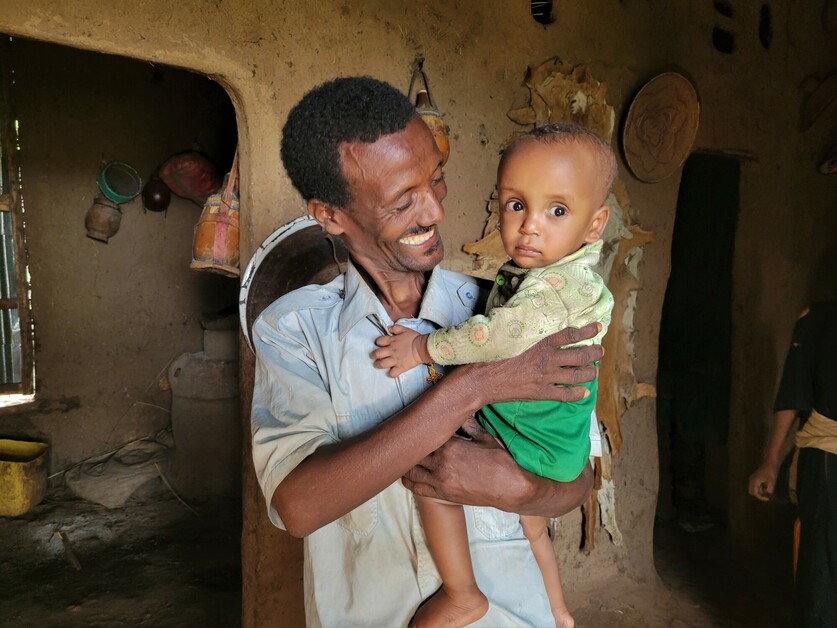
Women in Ethiopia normally spend around 16 hours a day with household chores such as fetching water, firewood, cleaning, cooking, crop harvest and looking after the children. These tasks are traditionally seen as the role of a woman and wife. “It takes a lot of time. I used to do this alone, just like every other wife in our community,” says Wubare. Wubare’s husband, Wagnew, 42, is part of a CARE SAA group where they talked about division of labor. “If we divide the workload, then women have more free time to help the family economically and have more time to take care of the children and support them. So, we decided to change the norm and men take on a new role now,” says Wagnew. Next to cooking breakfast for his family, his favorite task in the household is looking after the baby. “I am very thankful, and I am very relieved,” says Wubare.
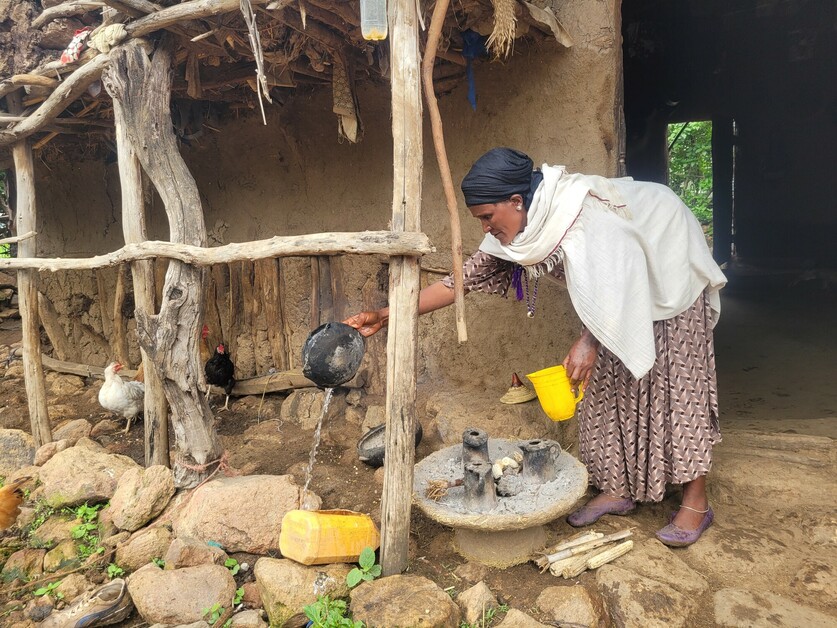
Fana*, previously she was a FGM practitioner. Now she is a member of a CARE SAA group. She is cooking in front of her house in a village in Ethiopia.
Every second girl in Ethiopia is being cut. In the 1970s, even nine in ten girls have gone through this process. “We are changing as a community. As a group, we came together to discuss the social norm and tradition of cutting, and we reject it now. But in the community, there is sometimes still a positive attitude towards it. We try to fight this,” says Terfa, a member of a Social Analysis and Action (SAA) group implemented in communities by CARE. SAA is a facilitated process through which individuals explore and challenge the social norms, beliefs, and practices that shape their lives and health.
Risks of female genital mutilation
“I started with the cutting of girls because I wanted to be loved by the community. As a practitioner, you are the main and important part of the ceremony. I gained a lot of social respect,” remembers Fana*, 38 and mother of four children. She was a traditional practitioner who learned the process by watching another practitioner. After she joined one of CARE’s SAA groups, she stopped her work immediately. “I regret cutting those babies because they were suffering. There was always a risk of them getting an infection or even dying because of what I did to them,” she continues. In the group discussions, she learned about the risk of fistulas, swelling, fever, infections such as tetanus, later problems with urination and menstruation, scar tissue, problems during intercourse, and the increased risk of childbirth complications such as difficult deliveries, bleeding, and the need to resuscitate the baby.
“We now understand the health consequences and the long-term damage,” says Terfa. The SAA group members have a system in place, where every member has a network of about five families that they are responsible for in the community. They raise awareness about the consequences of female genital mutilation (FGM) and report to the group if a family wants to go forward with the ceremony. “I now work against this practice. If someone in my network has a baby girl, I will go to their home immediately. I try to raise awareness. Five days later I come back to check on the girl,” describes Fana.
Checking on the girls
With this practice, the community of about 6,000 people has reached a 0% FGM rate. “Before we were at around 85%. In the last year, six women in the community gave birth to a girl. None of them were cut”, explains Terfa. Fana also notices a difference, “No one asks for my services anymore. No one has knocked on my door. I do the knocking now to check on the girls.” The practice is still common in Ethiopia being home to 25 million women and girls who have undergone FGM, the highest rate in Southern and Eastern Africa. FGM is primarily driven by gender norms and cultural practices that are held in place. “Most parents believe that the girls won’t be able to have sex physically if they are not cut. Others believe that she will not be beautiful and won’t be wanted. We made a lot of mistakes before,” concludes Terfa.
*name changed for protection reasons
